Frozen Sleep
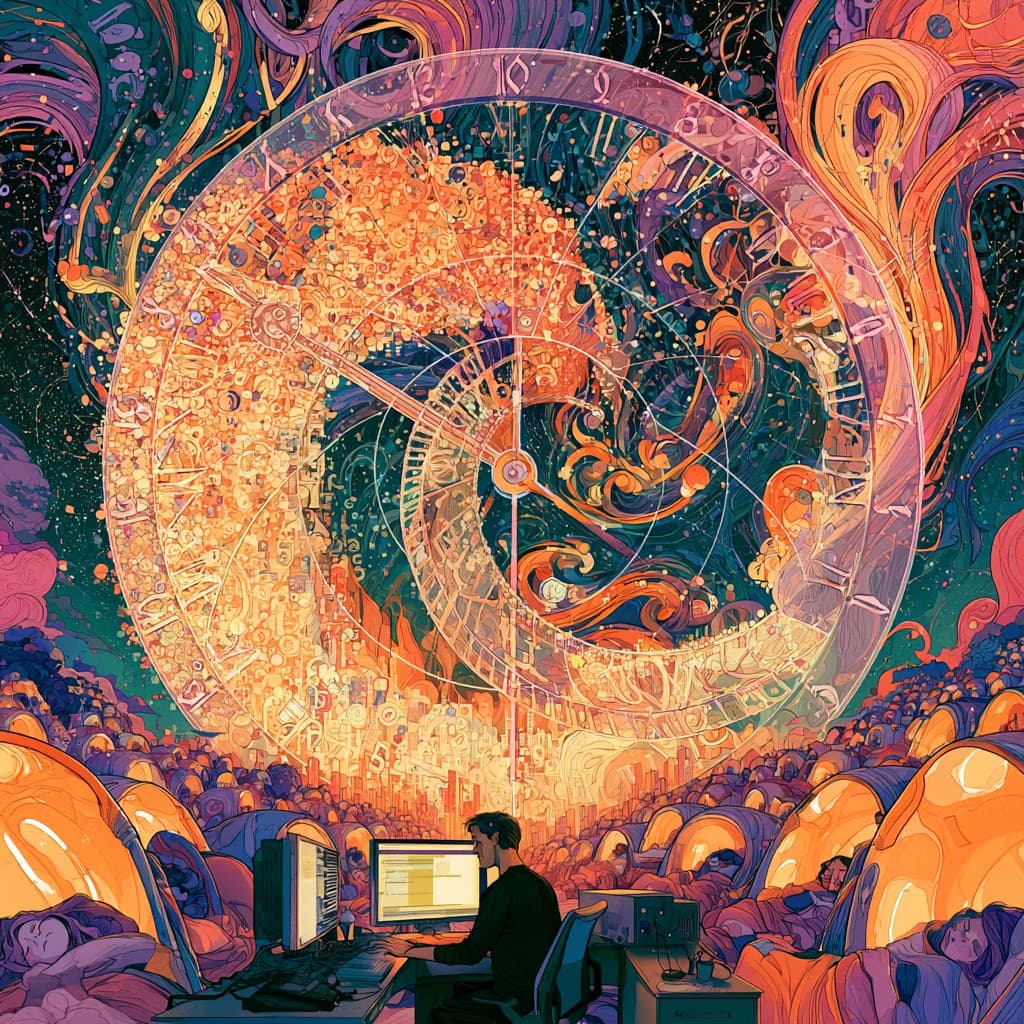
Lately there has been a lot of talk at work about work-life balance. They don't want us putting in fifteen-hour days the way they used to. They have worked out that there are people, people like me, for whom work is not the most important thing in life — for me it is mainly a living, and my real life is what happens after work. It matters far more to me that my son does well on tomorrow's English spelling test than whether the company makes one more million or one less. I have no trouble saying I'd take the company earning a million less this month if he came home with 100 instead of 90. A sense of proportion never hurt anyone.
I work at Freeze Sleep, the biggest company in the world selling "frozen sleep". I am not a senior manager. I don't even hold options. I am just another developer among the thousands the company employs. Developers are the factory workers of the twenty-first century, so I am a factory worker.
One of the things I hate most about the job is meetings, and mostly for one reason. Always, without fail, there is some egotist who turns up late and a team of ten just sits there waiting a quarter of an hour… a quarter of an hour times ten people is two and a half hours. The company pays two and a half hours of salary because some self-important idiot, usually a department head, doesn't give a damn about anyone but himself. And every time it happens the idiot looks rather pleased with himself, comes in smiling, half-apologising, and everyone can see there isn't a drop of apology in it — only contempt for other people's time. It is fairly ironic, that being the working culture at a company whose whole business is saving people time.
A person sleeps a third of their life. It is mad that until recently everybody simply threw that time away. From the moment people started using frozen sleep, that time stopped being wasted. Instead of living to ninety, a user can comfortably reach a hundred and thirty-five, even two hundred. The essential difference between ordinary sleep and frozen sleep is that you don't age in frozen sleep — a user only ages while awake. When the whole thing was invented everyone assumed it would be used mainly for space travel, but how many people actually go to space? So everyone who could started using it, not to travel anywhere, just to stop wasting time asleep. When the internet was invented everyone assumed that anyone with access to all the knowledge in the world would work wonders with it, and what did we get… cats and porn.
Children still aren't approved to use it and probably never will be; they say it interferes with their natural development. So children don't really use it, and in practice most users start at sixteen. Because some people use it and some don't, gaps open up and widen as people age. At twenty-five you can have the body of a twenty-year-old, at forty-five the body of a thirty-year-old, at sixty-five the body of a forty-year-old. It is quite something to watch everyone else grow old while you stay young, which is why almost everyone I know is a user by now. At the start there was a fair-sized movement of people who objected to frozen sleep on principle — naturalists — but their numbers keep thinning, and they die young too.
At night, when you are asleep anyway, nobody agonises about it; every user does it, and does it routinely. If you only use it at night you stay young by a little. But if you go for an extended programme — ten hours a night instead of eight, another day a week, and sometimes a long sleep of a whole year every seven years — the gaps between you and the people you grew up with get considerable. Programmes like that are far more complicated, and they have spawned a whole industry around what is called "long frozen sleep". There are companies now that maintain cover stories for people who don't want it known that they are under, and that will wake you if something genuinely important happens, a wedding you have to attend or, God forbid, a funeral.
Long before I worked at Freeze Sleep, back when I was still at university, I heard a story that lit me up. Truthfully I don't know whether it happened or whether it is just an urban legend. It went like this: a developer on some account-management system at some large bank decided to make himself a fortune, and instead of rounding off what came after the cent — the thousandths of a dollar nobody sees anyway — instead of rounding it he simply moved it into his own account. Since this happened to millions of people across an enormous number of transactions, many millions accumulated in that developer's account and nobody noticed… or perhaps somebody did notice, otherwise I would never have heard the story.
So, inspired by that story, I decided to run an experiment, and for some months now, every single day, I have been waking 86,400 people one second early. Who really cares about one second a day? How would you ever know whether you got up at six or at 5:59 and 59 seconds? Just opening your eyes takes longer than a second. I am not like those managers who are late all the time; the time I steal doesn't actually hurt anybody, and nobody pays for it. Every day I take a whole day from the universe — 86,400 seconds, 1,440 minutes, twenty-four hours — and not one person in the world knows about it.
Yesterday, for the first time, a query reached customer service: somebody complained that he had woken a second early. Customer service brushed him off and told him to check again the next day, and today they even called him back and it seems everything was fine. Obviously I've added an alert for complaints like that; either way I need to know if anyone starts getting suspicious. Every day I pick people at random, so there is no real chance of anybody losing a second day after day. I have already stolen more than ten million seconds and only now has one person noticed… four months, and only now, one person.
It is astonishing. I, nobody in particular, am affecting millions of people without their knowing. If I weren't doing it all their lives would be different — by a second, but different. Sometimes one second is the difference between meeting the love of your life and not. Sometimes a second is a matter of life and death: somebody who began their day a second earlier might have crossed at the crossing a second sooner, and I am the one who saved his life, or passed sentence on him.
There are very few people who affect so many others. The president of the United States addressing the nation, a scientist who has found a cure for another cancer we are fighting, a trillionaire philanthropist giving billions to end hunger, a great novelist who has touched millions with words. And me, on the same list. Touching millions, and if I keep going and widen the experiment, perhaps billions in time. I am changing their lives.
In one respect I am a little like those self-important managers who really do waste everyone's time. This day I take from the world genuinely makes me feel good. It gives me strength; these last months I would say it even gives me meaning. I know it is slightly insane, mainly because the day I take doesn't actually give me anything. It isn't as though that second travels over to me by some cosmic route, like the money in the story about the bank, and I end up living forever. It really doesn't work like that. It is just a day I take from the universe. And every day, taking another day, simply does me good.