The Great Summer Game
Every year, as the summer holiday comes closer, my kids ask me "are we going to play the Great Summer Game again?" For several years now the answer has been yes. The game gets more elaborate each summer, but the base stays the same: the kids do tasks through the summer, make progress, and collect points or prizes.
The first game was fairly primitive. I set tasks around the house: empty the dishwasher, tidy your room, wash the car, and each one completed earned stamps. At the end of the period the stamps bought presents, like a prize counter at an arcade.
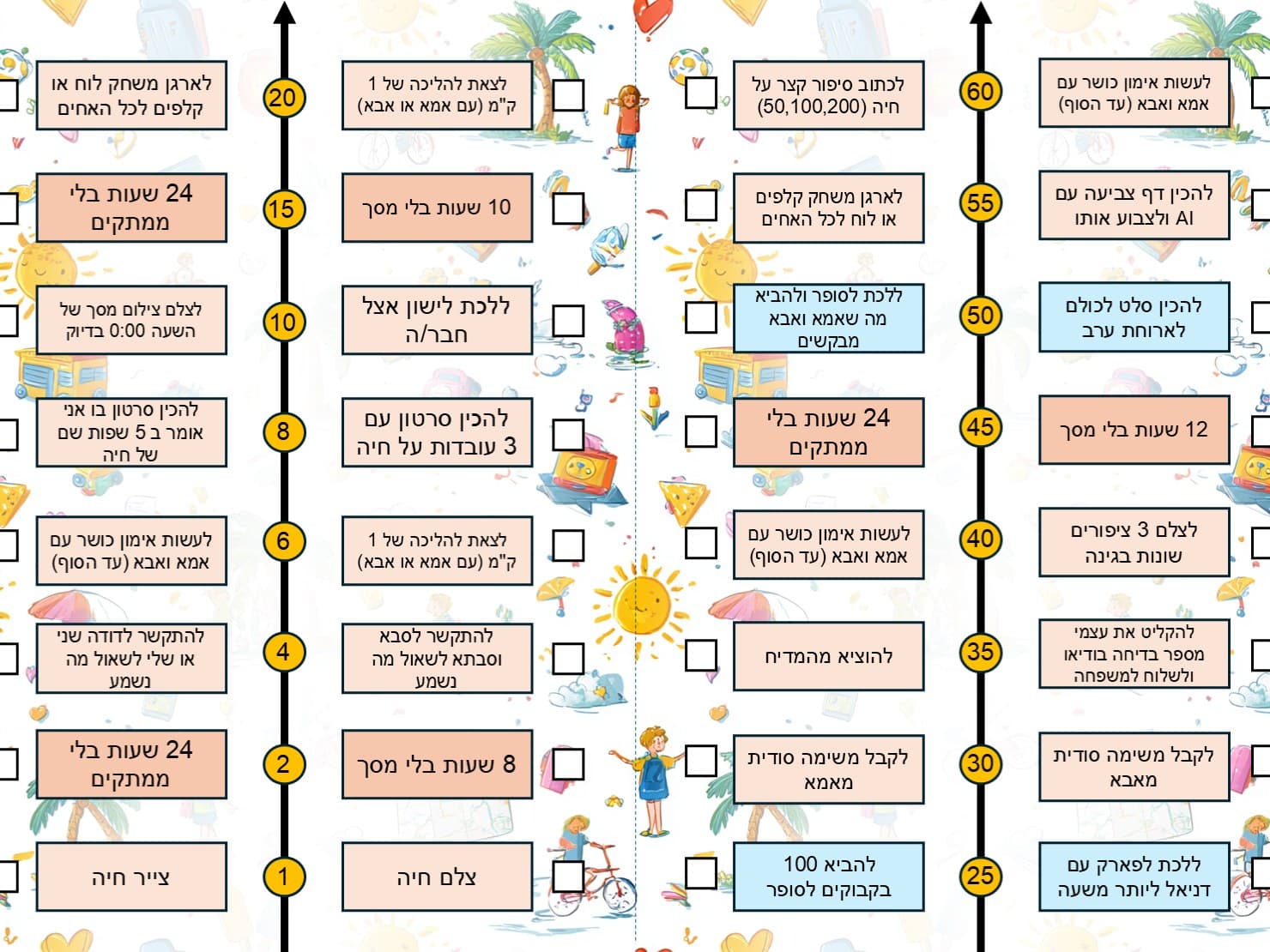
The version described here is far more elaborate, and went down much better with my kids. Instead of collecting stamps they move along a track. Every player has a progress map with 50 stages; each stage holds two task squares, and each square holds one task or more. The player picks one of the tasks, and completing it moves them to the next stage, which opens the tasks after it. Wherever they have got to when time runs out sets their score, and the score determines the prize.
Building your own version
Step 1 · Aims and a span of time
The Great Summer Game is a template. It comes out completely different for every situation and every player, so before thinking about tasks, think about the character of the game and what you want to get out of it. The aim might be getting your kids off the screen and outside, or getting them to help around the house, or to eat better. Any aim works, and so does a combination of several.
Set out clearly when the game starts and when it ends. How much time you have also tells you how many stages to plan for.
Step 2 · The tasks
This is the hardest part. Make a list of tasks that serve the aims of the game, the more you come up with, the more varied it will be.
- Write a difficulty level beside each task, a number from 1 to 10.
- Some tasks come in versions, which can grow your task list: a one-kilometre walk easily becomes a two-kilometre walk.
- Aim for more tasks than stages, though you do not need twice as many as a task can appear more than once.
- Set aside a few days for this, and don't do it in one sitting.
- Include tasks that take time, or that can only be done at a particular moment. Those are what stop a player running through the whole game at once.
Step 3 · Laying out the map
Here you become something of a game designer. Spread the tasks across the map so that whoever is playing wants to keep going. You can draw your own map or use the templates provided here.
- Keep tasks of similar difficulty in the same stage.
- Start with very easy ones and raise the difficulty gradually.
- Space identical or similar tasks apart.
- Several tasks can be merged into one bigger task.
- Give special tasks a special look and more points. They become anchors the player wants to reach, a little like bosses in a video game.
- Mix in bonus tasks, tasks that are not really tasks, but things the player would want to do anyway.
- Attach immediate prizes to some tasks, handed over the moment the task is done. It also makes those tasks likelier to be chosen.
Step 4 · Printing
A home printer is enough. If you used the templates here, cut each sheet in two and glue the pieces into one long map. With several players, print each of them their own.
Step 5 · The announcement
Announce the start on the first day of the period, hand out the maps and explain the rules.
Step 6 · The game itself
As it runs, check whether anyone is stuck on a task. If they are, offer to make the task easier or swap it for another.
Step 7 · The end
When the period is over, hand out the prize you promised.